Product overview
Get a complete view of the tools that power your business

Get a complete view of the tools that power your business
Let customers book and manage storage with ease

Manage your entire business in one place
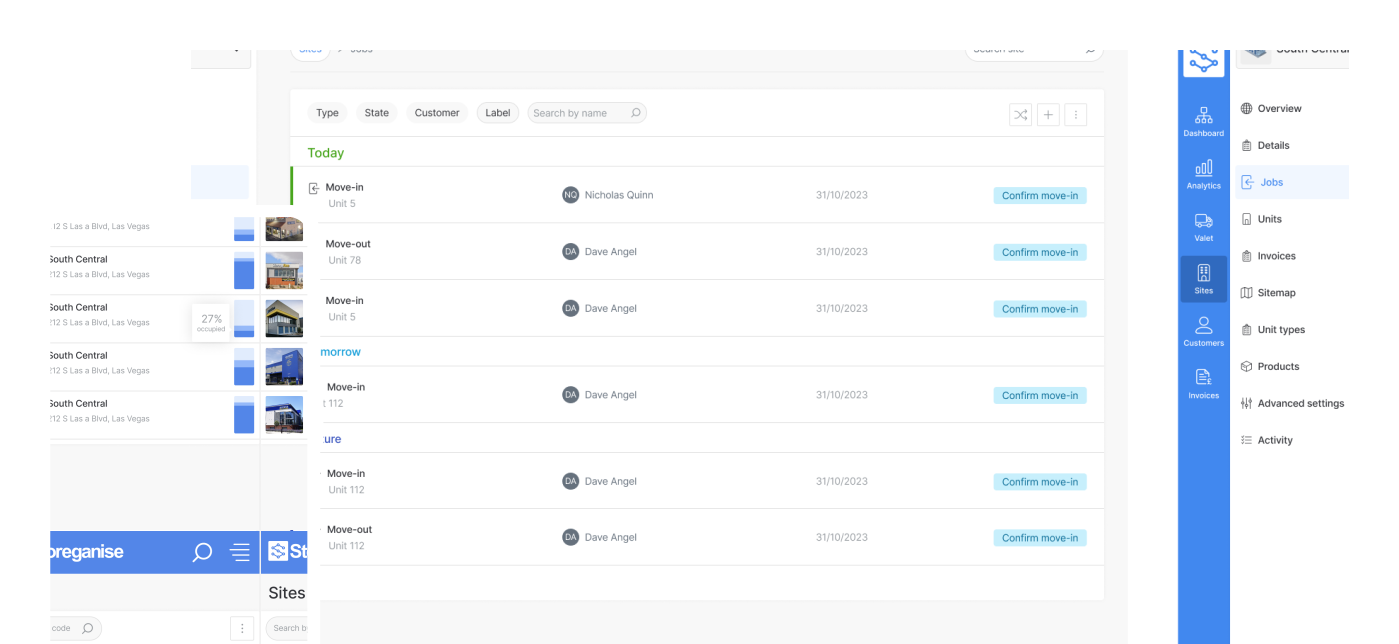
Attract new customers with a website built for self-storage

Extend your business logic with endless integrations

Can you make money with an empty building? Find out here.

Jack Colemanzo
2026-01-04
Suppose you have an empty building in a favourable location, such as a commercial hub, an industrial/manufacturing hub, or even close to a harbour or train station. In that case, you should be pleased since you’re on the road to financial stability.
If you’re well-informed, you can make a fortune, even if your building is in a less favourable location. One benefit of owning an empty building is that you only need a little time and money to make a profitable business.
There are several business opportunities for unoccupied buildings or other types of buildings. This guide is for you if you want to start your own business with an empty building, but are in need of business concepts.
Self-storage is a business where you rent out “storage units,” such as rooms, lockers, containers, and outdoor space, typically for a brief period (usually month-to-month). Notably, your empty building can also serve as a storage unit. The renters of self-storage facilities can be both people and companies.
Self-storage offers more control than full-service storage facilities, especially when managed through a software. The latter provides customers limited access to their possessions and relies on the storage provider to hold and manage them.
Learn The Exact Steps on How To Set Up Your Self Storage Facility In This 5 Minute Read
Key Lessons from Industry Experts
The Psychology of Self-Storage Pricing
How to diversify your revenue streams
Steps to set you up for success
On the other hand, a self-storage facility, when open, grants customers access to their goods anytime. Moreover, it allows clients to pack the storage unit as they want and store or remove items from storage whenever they desire.
To help renters pack and protect their belongings, some facilities sell boxes, locks, and packaging materials. They may even hire out trucks. You may offer any of these perks to make your self-storage business more attractive to customers.
To further distinguish themselves from rivals, owners of self-storage facilities frequently offer special services, including:

24-hour access,
Climate-controlled storage options,
Outdoor Parking for RVs, and
Lights or Power Outlets Inside the Storage Units.
Additionally, some storage facilities feature wire mesh open roofs, which are less safe than those with fully covered tin roofs. The latter offers more security and privacy, and you can charge extra if your empty building boasts a similar level of protection.
The burgeoning self-storage market should be enough to convince you to convert your empty building into a storage option.
In contrast to other industry asset classes, the self-storage business is fragmented. Individuals or small investors hold 80% of self-storage facilities.
Self-storage facilities are currently widespread throughout the world. The latest report on the European self-storage market released in 2022 by FEDESSA, the Federation of European Self-Storage Associations, revealed some eye-opening statistics. Top among these is that the European self-storage industry has seen a 70% growth in the last five years.

Here’s how many self-storage facilities currently exist across Europe (containers inclusive):
- 2,050 facilities in the UK
- 650 in France
- 580 in Spain
- 355 in the Netherlands
- 200 in Germany
Europe has an estimated 123 million square feet of lettable self-storage floor space distributed across 5,435 facilities. Moreover, there’s a 59% probability that rental rates will increase across the continent in 2022, compared to the meagre 13% in 2021. While this may be attributed to the recent inflation trend, it’s good news for current or intended self-storage owners like yourself.
To evict non-paying renters, self-storage facilities in the United States may arrange storage auctions or lien sales by their enforcement rights, detailed in the lien law of each jurisdiction. However, in Canada, The Repair and Storage Liens Act sets forth the procedure and legal criteria.
Facility owners must typically send a certified or registered letter to the tenant’s address on file with the facility, informing them of the unpaid amount before taking any other action. If the debt still needs to be settled, the facility must notify the public of the sale or auction.
In most states, this public notice must appear in a newspaper with broad circulation, though some states may permit online information on sales. Until the auction starts, the renter can pay their unpaid balance at any time, in which case the unit and its contents would no longer be up for auction (which, in some cases, may result in the entire auction being cancelled).
This simple guide will help you launch your self-storage business. By following these steps, your new storage company will be carefully thought out, correctly registered, profitable, and in compliance with the law.
A business’s capacity to meet demand is essential to its success. You may have trouble drawing in clients if your self-storage business is located in an area with rigorous competition but less demand. However, you’re much more likely to discover a continuous flow of customers if you choose a site with considerable business potential but still needs to establish competitors operating in the region.
In densely populated locations, there’s a significant demand for self-storage facilities. They’re useful in cities with a variety of housing options as well. People who are downsizing or temporarily residing in an apartment, for instance, frequently decide to store their goods until they can move into a larger home.
Fortunately, starting a self-storage business has lower startup costs than many of your other options — but there are still expenses to consider. Your calculations should include the cost of keeping workers on-site during business hours. It would help if you also considered the expenditures of cleaning supplies, upkeep, and advertising.

You’ll have a better sense of the annual expenses required throughout your first year of operation if you figure out how much you’ll need for the first month of business. As a rule of thumb, you should have at least one year’s expenses covered before starting a business.
Self-storage facilities are frequently gated and fenced to deter trespassers. Hence, it’d help if you remember this crucial aspect. In this case, an affordable, reliable gate and fence set is your best option.
There are several possibilities, but steel is usually preferred for fencing because of its affordability and durability. Many self-storage facilities also use aluminium gates.
A marketing strategy that will advance your firm should always be part of your plans for success.
At the very least, you’ll require a website and business cards. You might also consider using printed marketing materials and digital marketing services to promote your firm and grow sales if you want it to grow to its greatest potential.
Storeganise is an excellent platform for setting up user-friendly and SEO-optimised marketing websites tailored towards your self-storage business. You can get started when you book a personalised demo with us today.
You might be tempted to choose unconditioned units when you first start. However, the reality is that the contemporary self-storage consumer sector seems more interested in climate-controlled units.
If you don’t make an initial investment in climate-controlled units, you’ll probably have to make such changes later. This can get quite uncomfortable — once you already have clients renting your storage units, it might take a lot of work.
Finally, when starting your firm, you should strive to make sound business decisions. This involves maintaining thorough financial records and refraining from scrimping on essential things.
It’s best to seek assistance if you need help in a particular area until you’re confident that you can do the task independently.
Remember that it costs money to make money as well. Before realising any gains, you might need to spend a little money. However, spend as carefully as possible, and don’t go overboard with your spending throughout the first year.
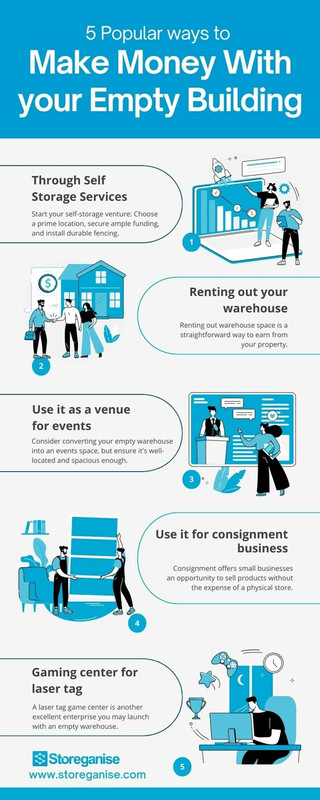
Apart from running a self-storage business, here are other promising options for raising funds with an empty building. We’re confident that at least one option should work for you.
Leasing out the space is one of the most straightforward ways to profit from your warehouse.
When renting warehouse space, there are a few things to consider. You must first locate companies that require space, such as office space or conference rooms. You can accomplish this by networking with other businesses in your sector or conducting an online search.

Many platforms today, including Storeganise, let you advertise your space, receive inquiries from potential tenants, and manage various business models from a single platform. Consider booking a personalised demo today to get started, or read up on the following case studies for more info.
Negotiate leases once you’ve located a few possible renters. Also, include provisions that safeguard your long-term business interests and your warehouse.
Finally, you must monitor your tenants to ensure they use the area as planned. Ideally, you won’t have to take on the role of a controlling landlord.
One of the enterprises you may start with an empty warehouse is an events space. This is appropriate if your warehouse is well-located and large enough to hold many people. There are two possible options for renting out your vacant warehouse: directly to individuals who wish to host events, or to an organisation with an established clientele base.
You should only directly manage to rent out your vacant warehouse if you have the necessary experience running such a business. Please be aware that renting out your empty warehouse as an event space requires you to make a financial commitment to refurbish it, bring it up to standard, and consider licensing laws.
Consignment is another successful business that you can launch with your vacant building.
What is a consignment shop, to begin with?
In a supply chain arrangement known as consignment inventory, a product is sold by a retailer, but ownership is held by the supplier until the product is sold.
A consignment store, therefore, sells reasonably used items cheaply. It could be a wide range of items, including furniture, toys, books, tools, musical instruments, office supplies, machinery, sports equipment, clothing, shoes, and other fashion accessories.

The consignment agreement means that you barely require any cash to start a store because you gather items from people who were already cleaning and organising their garages, businesses, homes, and wardrobes. By the way, you’d automatically be assisting them in getting rid of the goods they don’t want, whilst benefiting financially.
Consignment offers small businesses the chance to sell their products without incurring the cost of a storefront, which is its main advantage. Without the assurance of significant sales, paying rent for a retail store and a salary for staff to run it is expensive and dangerous. For many small businesses, there are other viable alternatives.
Small businesses can start a distribution business by selling products on consignment, without investing in a storefront, hiring staff, or paying rent. Instead, the consignee covers the expense in exchange for payment from sales of the goods.
A consignment arrangement allows you to sell products on a physical sales floor while also putting them in front of customers and potential customers to increase brand and product recognition.
Moreover, selling on consignment enables a small firm to sell more goods. This can draw in more clients and set them out from the competitors.
A laser tag game centre is another excellent enterprise you may launch with an empty warehouse.
A tag game that uses lasers is called laser tag. Each player in the game of laser tag typically puts on infrared-sensitive targets, which are frequently built into the arena where the game is played.
It’s a thrilling game where players put on electronic vests and “tag” each other. Each player tries to hit opposing team players by shooting at their sensors.
Securing a large building that’s big enough to contain a full-sized laser tag arena, spectator stands, changing rooms, and appropriate parking space is the major stumbling block in launching a laser tag arena, indoors or out. Additionally, it needs to be in a place that might draw the customers who would pay to use your laser tag arena for other social occasions.
A laser tag player may be charged $7 for one game, $13 for two, $19 or $20 for three, etc.
In the monogramming industry, gifts are artistically designed with two or more alphabetic letters. Cups, custom t shirts, towels, bags, wedding invitations, caps, and jackets are possible gift items. You can consider going beyond monogramming and implementing custom embroidery to add designs other than just alphabetical letters. In that light, one of the most straightforward methods to make money with an empty building, with or without experience, is to start a monogramming business.

Here are some measures to take to establish your monogramming business:
Welding and fabrication businesses are yet another worthwhile venture you might launch with an empty building.
Welding is a sculptural or fabrication process that joins materials by inducing fusion, as opposed to lower-temperature metal-joining methods like brazing and soldering, which don’t melt the base metal. These methods typically involve joining metals or thermoplastics.
Suppose you’re looking for a business, you may start with your empty building to generate money. In that case, starting a welding and fabrication company is advisable.

With maximal growth in recent years, this constantly expanding industry appears to be expanding the fastest. A minimum growth rate of 6% per year has been estimated for the welding sector.
More than two-thirds of this sum comprises filler metals and conventional electric arc welding equipment. This industry has numerous subsectors, and an accurate study has identified distinct growth patterns for each subsector.
It’s crucial to remember that the requirement to weld metals together to satisfy varied purposes has existed since the beginning. The welding sector is thought to consistently and significantly demonstrate a return on your investment. However, you must complete welding training to become certified before starting a welding business.
Additionally, you can establish a newspaper or magazine business to make money with an empty building. You can either start from scratch to create your magazine or newspaper or choose one from a company and customise it.
Finding a suitable location and the necessary materials—such as printing equipment and a small team of editors to aid in writing—are the major hindering factors to starting this business. Still, magazines offer an excellent platform for selling goods and services and are visually appealing and entertaining to read.
The following tips will help you create a stunning print or digital magazine:
1. Choose a topic:
A magazine needs a topic to exist. Consider your specialisation and the target audience. You need a distinct, cohesive theme if you’re creating a glossy magazine with beautiful photographs for the tourism board or a catalogue featuring knit caps or handmade jewellery.
Music, movies, travel, current events, fashion, health and fitness, leisure activities, sports, gardening, and interior design are some possible topics that may pique one’s interest.
2. Choose a title:
At this point, you’ve decided to launch a lifestyle magazine; now, it’s time to choose a brief and direct title. Remember that your title will serve as a representation across platforms and for a long time (in the case of some magazines, hundreds of years).
3. Pick a cover article:
Every magazine has a cover piece that gets the most attention regarding design and content. For example, in the case of a lifestyle magazine, it’ll feature a lifestyle that’s described in-depth inside. This will be a thorough interview with the star on the cover of a magazine that focuses on celebrities.
4. Identify your cover photo:
What attributes does a good cover have?
Because your eyes are drawn to the top and centre of the page, your cover image should contain its most intriguing components. Make sure the image you’re using is of a high calibre. A minimum resolution of 300 PPI (pixels per inch) is required for print magazines.
Your cover image is what attracts your audience. Hence, it should be large and simple to read at a glance, match the theme of your magazine, and have appealing colours.
5. Carefully curate the body articles:
A magazine’s main lure is frequently its articles. Choose whether you’ll write every section yourself or rely on independent writers or other external contributors. This procedure could take several weeks or even months, depending on the size and breadth of your publication.
A college campus publication will have staff writers, editors, and calls for submissions from outside sources. The reach will be significantly broader for a magazine that’s professionally produced.
6. Create a table of contents:
Once all of your articles and the photos that go with them have been assembled, create a table of contents. The table of contents in your magazine’s template may appear on pages 2 or 3.
A salon is another venture that may be established in an empty building and make you money. Before you get started, you’ll need to purchase all the tools, including the chairs, mirrors, and other things hair stylists use to style hair. Obtaining a licence from the city is also necessary if you plan to start this business.
Furthermore, it’s important to think about the site. Since the location affects both the local population and the activity of your firm, it’s advisable to start a unisex salon.
The beauty industry is thriving and is taken seriously in the United States and other countries. Among the many services, you can provide braiding, weaving, and eyelash maintenance.
According to Statista, in the US alone, the beauty salon industry’s market size grew from $40 billion in 2002 to nearly $50 billion in 2021. It’s no surprise that people constantly desire goods and services that will make them look and smell great. Besides, celebrities helped influence industry trends through personal preferences or paid endorsements.
You may also launch an IT business with an empty building. Before starting this business, you must purchase computers and other tools like printers and scanners.
Every day is interesting because the information technology sector is always changing, according to Greg Davis, president of South Coast Computers, a 1988-founded full-service outside IT company. According to Davis, it doesn’t take a lot of money to establish an IT company.

Before starting an IT business, you must complete the following procedures and choose whether to provide basic or specialised services:
A museum is like a dynamic book — you enter and are immediately taken to another realm.
Making money from a museum is possible in an empty building. A museum informs and inspires, whether it’s an art gallery where you can see outstanding pieces by regional artists or a history museum where you may explore rooms from a bygone age.
Starting a museum may seem like a daunting endeavour, but if you divide it into manageable steps, it becomes a lot less intimidating.
Here’s what you must do:
Finding a niche is just as important as deciding what kind of museum you want to open. Worldwide, there are almost as many different kinds of museums as there are. For instance, you may start a museum dedicated to video games or boats.
Choosing how you’ll pay for your museum and its exhibits is the next step after determining what kind of museum you wish to start.
Future acquisitions and displays would ideally be funded by revenue generated by the museum itself. To start a museum with your current resources, including the ability to pay for the first overhead, staffing, and displays, is necessary before you can advance that far.
Location is crucial to establishing a successful museum and is necessary for many forms you’ll need to complete.
Your museum’s location may depend on the kind of museum you’re operating. A historic home museum, for instance, can only be established inside a historic house.
You’ll need to formally fill out some documents to declare your new company as a museum. These consist of the following:
Articles of incorporation: This legal document must be submitted to your state and includes your company’s name, address, and general goal. State-specific requirements differ, but you can find out more by contacting your secretary of state or attorney general’s office.
Employer identification number: This must be obtained from the IRS for tax-related purposes.
Nonprofit status: Not all museums don’t function as nonprofits, but most do. To find out if your museum qualifies, consult a nonprofit attorney. Once you have nonprofit status, you can concentrate on obtaining IRS tax exemptions and local or state exemptions.
The backbone of your museum’s operation will be its staff. Every employee of your company, from the founding members (such as curators and a board of directors) to the tour guides and gift shop staff, is essential to ensuring the operation operates effectively and receives favourable community ratings.
Liquid air freshener manufacturing is one of the businesses you can start if you’re an aspiring entrepreneur seeking a decent and lucrative business venture to establish in your vacant warehouse. This is especially true if you’re thinking about starting your own small business in the chemical sector.
You may successfully launch your own liquid air freshener manufacturing business with a small amount of startup money. There’s a sizable market for liquid air fresheners, so you must develop distinctive and pleasing aromas to remain competitive in this sector.
You can create a freight packaging and logistics company from your vacant warehouse, another excellent business venture. In addition to consolidating freight shipments, creating trade documents, packing, crating, and other transportation-related preparatory services are offered by a freight packaging and logistics company.
A freight packaging and logistics services provider offers packing and crate-making services to the transportation industry.

If you want to start a freight packaging and logistics business, ensure it’s focused on customers’ demands. Individuals in your neighbourhood, in your nation, or on a global stage could be involved.
As long as some businesses and individuals will use your services, you can run this form of business from anywhere in the nation. Even though it requires a lot of capital, providing freight packaging and logistics services will likely prosper.
Before you rent out your empty building for profit, it’s best to perform the following:
1. Evaluate your space.
To determine what kind of solutions will work best in your location, gather the square footage, amenities, and facilities. Studios, for instance, will require adequate lighting and storage space. On the other hand, facilities for professional growth will require sizable meeting rooms and strong WiFi.
2. Verify legality.
Before using your empty building for storage services or other businesses, check your area’s laws, codes, and zoning regulations. It’s also important to double-check local regulations regarding safety, property capacity, inspections, and other issues.
If you want to rent out empty building space but need to retain ownership of the building, confirm that you have the right to sublet to others.
3. Calculate the cost.
New furniture, storage areas, and cleaning staff are all necessary steps before you open your space to the public. You must consider these expenses when setting your prices to make a profit. Also, background checks on your clients could cost money.
Remember that even though you’re launching these businesses with an empty building, you’ll still need cash to upgrade the building. Some of the listed business options—like an IT company and liquid air freshener production company—might require the installation of machinery and equipment and wall partitioning to make running the business much more efficient.
Perhaps you intend to convert your empty building into a self-storage option and desire seamless business operations. With Storeganise, you can build effective marketing websites for your self-storage businesses. Our platform smoothly converts visitors to customers thanks to the Storeganise Customer App integration and other self-storage business-powering services and solutions.
Book a personalised demo to see how we can help scale your business.
Most warehouse buildings are utilised for storage and distribution. Thus, there’s no need for office space, and most of the area will cater to storing goods and inventories.
You can use an empty building for various businesses and services. For instance, you can use it for self-storage services or as a warehouse for storing products. You can also use the building for consignment business, as a salon, museum, or welding and fabrication services.
You can publicise your warehouse through conventional print, television advertisements, and short video adverts on social media platforms, such as Facebook and YouTube. However, it’s important to have a defined budget before starting. Additionally, you can build a personalised, user-and SEO-friendly website on Storeganise to advertise your warehouse business.
The rent you collect from your warehouse or self-storage facility will generate a steady flow of income as long as you keep attracting tenants and maintaining the occupancy of your property.
You could use the opportunity to increase your tenant’s monthly rate as the demand for rental properties rises. However, knowing how to increase prices without angering your customers is important.
You can launch a distribution company by selecting your product, picking a niche for yourself, establishing your product sales strategy, choosing your inventory control strategy, and calculating the right amount of storage. Further steps include applying for a business licence, enhancing your business skills, and reaching out to producers.

Jack Colemanzo is the Head of Sales at Storeganise, based in Barcelona. With a strong background in the technology industry, spanning software development, sales management, and team leadership, Jack is a catalyst for growth and a builder of positive team culture.
View bio